Using App With Hearing Aids:
It is possible to use our app in conjunction with hearing aids, although we cannot guarantee results.
Of considerable importance is that the earphones on the headset be placed in such a way that they at least partially overlap the hearing aid microphones, allowing for unimpeded transmittance of the pitch-lowered bird songs into the hearing aid. For "in the ear" aids, this is easy to accomplish because the headset earphones are naturally placed over one's ears, directly over the hearing aid mics.
Over-the-ear aids create a greater challenge because the hearing aid mics are generally located in the top center of the aids, which lie slightly behind the upper portion the ear. Our recommended headset, which utilizes the Koss KSC75 earphones, cannot easily be positioned over the top of the ear. In fact, it's almost impossible to position the earphones over the hearing aid mics because the ear hooks on the earphones are designed to be placed behind the upper portion of each ear, exactly where the hearing aids reside.
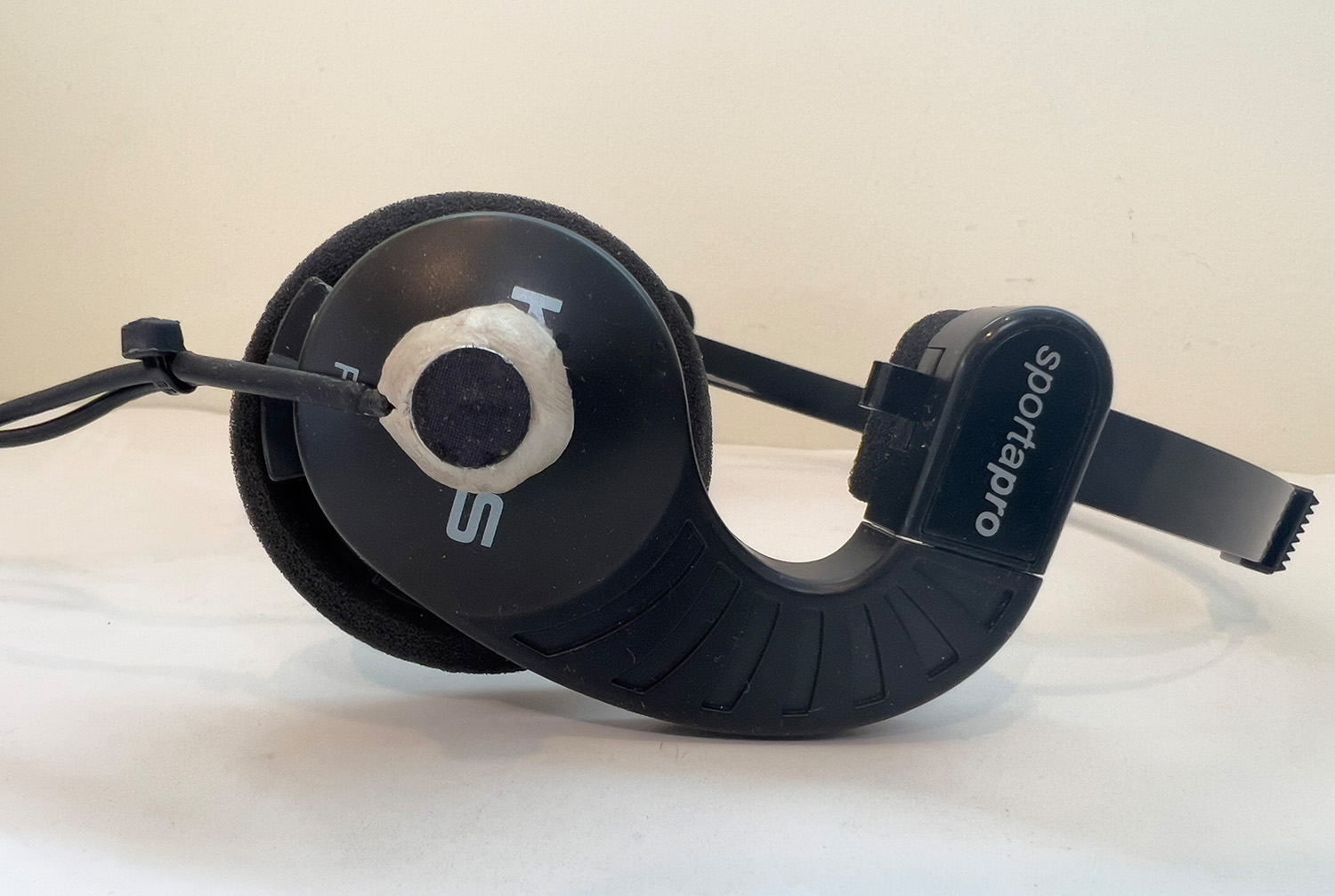
So ... for use with over-the-ear hearing aids, we recommend using the Koss SportaPro earphones, pictured below. The SportaPro utilizes a head band that can be worn over the top of the head or else around the back of the neck. As such, the earphones can be easily positioned so that their upper portion rises slightly above the upper portion of the ear, allowing for the pitch-lowered bird songs to be fed directly into the hearing aid mics.
The SportaPro earphones are readily available for around $25 US. In North America, they can be ordered here: https://www.amazon.com/dp/B00001P505
To build the modified headset, order the micbooster kit that does not include the Koss KSC75 and then build your headset using the SportaPro instead. .

Ordering the Micbooster Headset Kit
Click Here to order the headset kit (either the full kit or a partial kit) from micbooster.com, which is located in the United Kingdom. Prices are in British Pounds. If you are ordering from the United States, the website should detect your location and display a price of 143.20 pounds (about $170 USD) for the full kit. NOTE: If a higher price is displayed, please don’t worry … the proper price will appear in your shopping cart once you’ve registered your account and entered your US mailing address.
Disclaimer: Hear Birds Again does not profit financially from the sale of headset kits, nor is our arrangement with micbooster an exclusive one; we remain open to other headset possibilities and sources.
Headset Assembly Video Tutorials
The full micbooster kit includes all the required components and makes it very easy for individuals to complete construction. The low-noise mics are already professionally soldered to miniature cables equipped with connector plugs. All that needs to be done is mount the mics on the headset using mounting putty (which is easy), twist the cables by hand, and then secure the cables with several cable ties. The following videos convey everything you'll need to know to assemble the headset:
Go here for enlarged versions of the following videos.
The Binaural Headset - Part 1: Introduction
The Binaural Headset - Part 2: Kit Components
The Binaural Headset - Part 3: Rode AI-Micro Adjustments
The Binaural Headset - Part 4: Assembly Instructions
How to Hook-up the Rode Ai-Micro Audio Interface
CAUTION!: It is important to properly adjust settings for the Rode AI-Micro in order to prevent annoying feedback squeal:
Our recommended headset requires the use of the Rode AI-Micro interface, which will route the headset mics inputs into one's mobile device and the device's output (the pitch-lowered bird songs) back to the Koss Earphones. In order for this to work properly, it will be necessary for you to download Rode's RodeCentral application and then adjust the settings. The procedure is as follows:
1. Download RodeCentral and then open the app.
2. Connect your Rode AI Micro interface to your mobile device. RodeCentral should then automatically detect the audio interface.
3. TURN OFF the "Direct Monitor" option (the bottommost setting). CAUTION: If left enabled, you will probably experience loud feedback squeal!
4. Adjust other settings as as shown in the following screenshot of the RodeCentral user interface:

Once the direct monitoring setting has been disabled, everything should work fine and you should not have to use the RodeCentral app again, except perhaps to occasionally check for updates to the Rode AI Micro firmware (RodeCentral automatically detects if your current firmware is out of date).
Do It Yourself Component List
We encourage experimentation with regard to headset design. Our "recommended" design (available in kit form) is the result of extensive field testing, but it is certainly not the only possible solution. So, we hope that a number of do-it-yourselfers will tackle the headset problem on their own and come up with innovative solutions. To enable such efforts, we provide a full list of components below.
Headset Component List For Do-It-Yourselfers (North American Sources):
- Koss KSC75 Clip-On Stereo Headphones - $19.99
- Rode AI-Micro Ultracompact 2x2 USB Type-C Audio Interface - $79.00
- Super Low-noise Microphones AOM-5024L-HD-R - $3 each with quantity discounts
- Mogami W2368 Miniature Unbalanced Mic Cable - 15 cents per foot
- Neutrik Rean 3.5mm male plugs for mics - $2 each
- Gorilla Mounting Putty for mounting mics on to headset - $10
- Small 4" cable ties - $5 for 200
- Badge Clips to hold mic cable - $12 for 100
- OPTIONAL: Crossbody carrying bag for for iPhone, Rode Adapter, and extra cable - $10
UK-based Micbooster is also a trusted source of components, especially for UK and European Do-It-Yourselfers:
Ordering the Headset Kit from Micbooster:
Click Here to order the headset kit (either the full kit or a partial kit) from micbooster.com, which is located in the United Kingdom. Prices are in British Pounds. If you are ordering from the United States, the website should detect your location and display a price of 142.55 pounds (about $162 USD) for the full kit. NOTE: If a higher price of 171 pounds is displayed, please don't worry ... the proper price will appear in your shopping cart once you've registered your account and entered your US mailing address.
The full micbooster kit includes all the required components and makes it very easy for individuals to complete construction. The low-noise mics are already professionally soldered to miniature cables equipped with connector plugs. All that needs to be done is mount the mics on the headset using mounting putty (which is easy), braid the cables by hand, and then secure the braid with several cable ties. The following video shows how this is done:
Note: A video demonstrating the assembly procedure will soon be added here.
Disclaimer: Hear Birds Again does not profit financially from the sale of headset kits, nor is our arrangement with micbooster an exclusive one; we remain open to other headset possibilities and sources.
Do It Yourself Headsets:
We encourage experimentation with regard to headset design. Our "recommended" design (available in kit form) is the result of extensive field testing, but it is certainly not the only possible solution. So ... once our app is published, we hope that a number of do-it-yourselfers will tackle the headset problem on their own and come up with innovative solutions. To enable such efforts, we provide a full list of components below.
Headset Component List For Do-It-Yourselfers (North American Sources):
- Koss KSC75 Clip-On Stereo Headphones - $19.99
- Rode AI-Micro Ultracompact 2x2 USB Type-C Audio Interface - $79.00
- Super Low-noise Microphones AOM-5024L-HD-R - $3 each with quantity discounts
- Mogami W2368 Miniature Unbalanced Mic Cable - 15 cents per foot
- Neutrik Rean 3.5mm male plugs for mics - $2 each
- Gorilla Mounting Putty for mounting mics on to headset - $10
- Small 4" cable ties - $5 for 200
- Badge Clips to hold mic cable - $12 for 100
- OPTIONAL: Crossbody carrying bag for for iPhone, Rode Adapter, and extra cable - $10
UK-based Micbooster is also a trusted source of components, especially for UK and European Do-It-Yourselfers:
The Binaural Headset - Part 1: Introduction